Showing: 21 - 30 of 52 RESULTS

What is Roleplay? #18: Narrative Worldbuilding with Samuel Poots

Welcome to Episode 18 of ‘What Is Roleplay?! 
This episode we are joined by Samuel Poots to discuss Narrative Worldbuilding
Worldbuilding is an important cornerstone of all writing and especially important when writing roleplay games - the process of designing an environment for the story or the game you are creating. Samuel Answers the Question 'What is Narrative Worldbuilding': Designing the environment in such a way that the location can tell it's own story as well as creating a space that allows for stories to emerge naturally. Designing the world with narrative hooks that allow for stories to happen as the players encounter them. Using questions that add flavour to the world. There are two approaches to this - the GM spends a great deal of time before the game doing all of the narrative world building, writing the lore which sets out the story - OR - the GM has short touch points, perhaps just 100 words maximum, that set the scene for the players but allow for lots of personal interpretation and for the players to have more space to contribute to the story. The characters themselves have stories to tell. CM & Samuel spend a little too much time discussing cutlery! What if there was a world in which anthropomorphic cutlery were at war and the spoons had been banished to the desert biome? The GM has a great deal of influence over the use of narrative world building - rather than shutting down player suggestions, Samuel …

What is Roleplay #17: Teaching Games with Aviv Or & Eran Aviram

Welcome to Episode 17 of ‘What Is Roleplay?! 
This episode we are joined by Aviv Or and Eran Aviram to discuss teaching games

Aviv & Eran's work 'The Crystal Heart' and how it uniquely teaches readers to roleplay, specifically to play the Savage Worlds RPG Their use of narrative to explain how to play, based on the assumption that the reader has no prior knowledge The time and effort they have put in to developing the ability to teach games through the graphic medium, such as the use of humour, and colour (to indicate who's turn it is) The importance of aesthetics and atmosphere when teaching someone a game - open the rulebook on a fun page with graphics, use colour dice, create a comfortable environment. Know your audience - what will this person enjoy, what will draw them into the game? Pick the right game - something that is colourful and well set out will help you learn the game and teach it to others Set up a specific scenario for your new players, so they have a basic understanding & something to work with: 'Let's play a fantasy adventure where we will be rescuing a princess from a fearsome dragon'. Then as you explain the rules they will be able to refer back to the scenario Being a good player means taking part in the shared social contract - agreeing as a group what your desired outcome is and then not doing things that negatively impact on that …

The Dispossessed with Juliet Kemp

This month CM Lowry is talking to author Juliet Kemp, about The Dispossessed by Ursula K. Le Guin in ‘This Book I Read...

Topics covered include:

Ursula K. Le Guin's hero status amongst fans of Speculative Fiction and Sci-fi The mind blowing impact it has had upon Juliet's life The two planets of Anarres & Urras and the contrasts between them - both in terms of flora & fauna but also in terms of political and social systems. Sometimes subtitled 'An Ambiguous Utopia', The Dispossessed explores themes of late Capitalism, Anarchy & Time. It's a very political story. The idea that revolution is a continual process, and something that we as individuals must embody and encapsulate The concern that structures, even within anarchist societies, can be calcified and rigid, not allowing for the transmission of new ideas - so it's everyone's jobs to continue to be alert and continue to advance the revolution. The way that Le Guin uses two story lines that start out disconnected but end up converging Juliet's favourite things about the book, including the beauty of Le Guin's writing and the detailed working out of what an Anarchist society might look like in practice. Juliet's challenges with The Dispossessed, such as the dryness of Le Guin's writing at times and the heavy going philosophical content. There are also issue surrounding Le Guin's gender portrayals, which can in part be explained by the times it was written in (1970s), and the fact that …
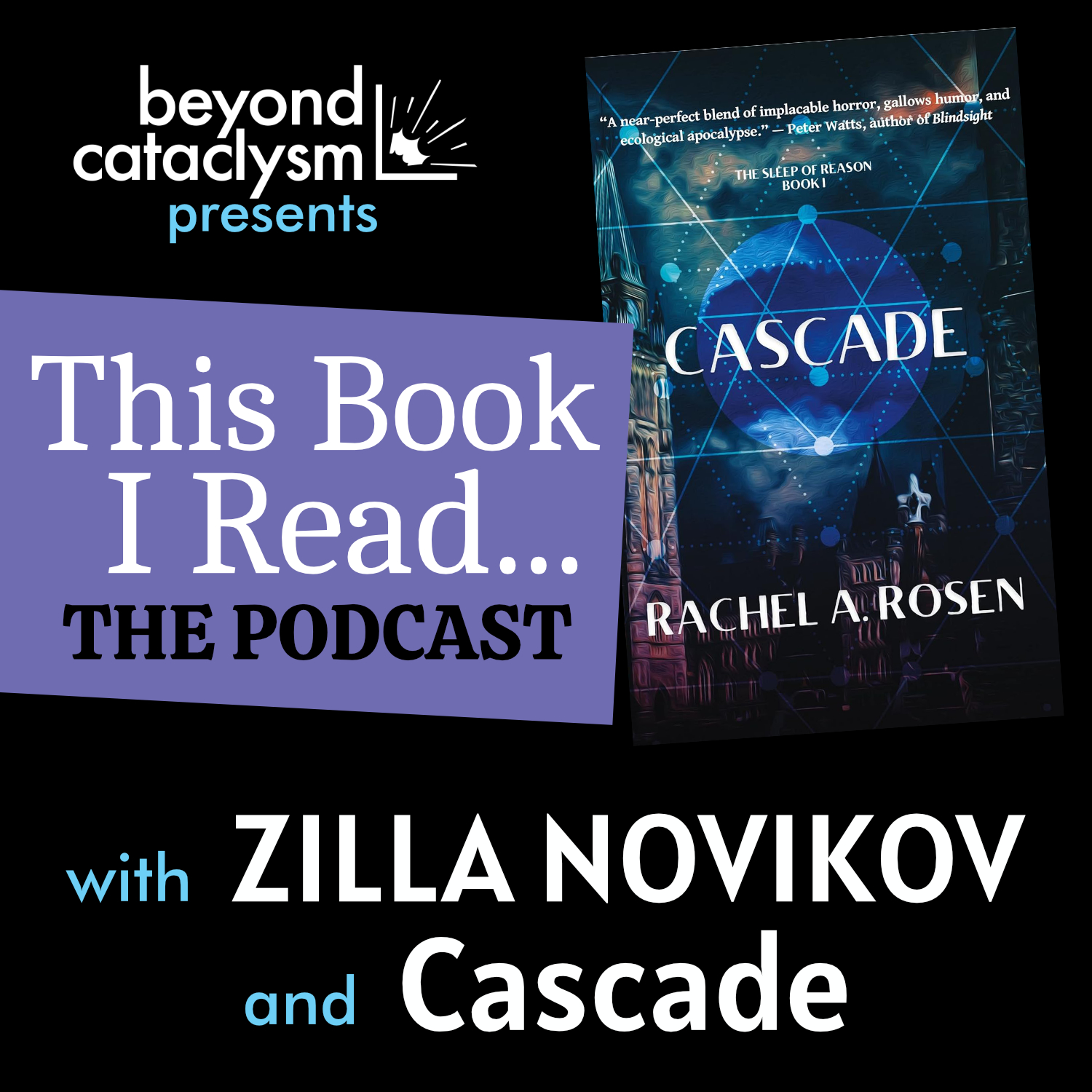
Cascade with Zilla Novikov

This month CM Lowry is talking to author Zilla Novikov, about Cascade by Rachel A Rosen in ‘This Book I Read...

Topics covered include:

The premise of the book, which is that people are trying to affect change and fight against an impending crisis from within the existing power structures and, unaspiringly, this doesn't go too well. The use of dark humour in Cascade to deal with the serious socio-political issues of our times such as the rise of fascism and climate nihilism. The use of magic to help the protagonists fight off these evils. Rosen's includes of characters from various indigenous and marginalised people groups as a way to highlight their plight. Zilla shares a quote, that really helps to illustrate how timely Rachel's writing was. None of us are out of harms way, we all need to be aware of changes going on in our world and how they can affect us. The beauty of how human the characters in Cascade are, and that they live daily lives, like all of us. This helps to fight against the dehumanisation and 'otherness' that often causes people to hate each other. The cool way that magic works in Cascade, and it's limitations. Instead of being liberating, magic can be incredibly frustrating. Rosen brings a certain sense of realism to the ways magic would affect everyday life, for example, being able to see every possible outcome causing the character huge amounts of anxiety and crippling their love …
What is Roleplay #16: Dungeons with John Dodd

Welcome to Episode 16 of ‘What Is Roleplay?! 
This episode we are joined by John Dodd to discuss dungeons
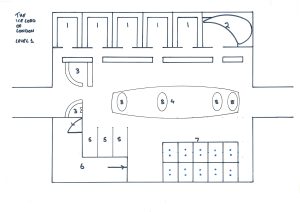
The intrigue of The Dungeon - why would someone build this, what was it for, how did it get here? You're not supposed to be there! Maps as promises - they guarantee excitement, adventure and maybe treasure Mega-dungeons -  Architecturally impossible structures that might prove impossible to explore in one lifetime The joys of having almost too much space and level of detail to explore The beauty of sci-fi and fantasy allowing you to bend the realms of what is reasonable to create impossible mega-structures Dungeons are a nightmare - you're in the dark with no idea what you are doing or where you are going. Perfect fodder for an adventure. Key Things A Dungeon Needs: Light - Yet there is an absence of it and the dungeon doesn't want you to have it! The contrast of light & dark. Dark as a representation of the unknown. Treasure - If someone has gone to all the trouble of building a dungeon there must something interesting down there! A great evil? A King's ransom? Why is it there? There has to be something that draws people in to the dungeon, where they know they shouldn't be What Now? - So you have a reason to be there and you've used light to find the treasure. But you've got to wonder what now? Something or someone has taken over this Dungeon, as they're …

What is Roleplay #15: Diceless Roleplay Games with Côme Martin

Welcome to Episode 15 of ‘What Is Roleplay?! 
This episode we are joined by Côme Martin to discuss diceless rpg
Chris & Côme discuss many different Roleplaying Games that don't use dice & explore the spectrum of games from completely controlled by fate, to the other end of the spectrum where the only narrative input in the game is the things your saying to one another around the table. The mechanics of dice use and how they can be replaced with other items such as a pack of cards The ways that a deck of cards can be broken into different groupings for use in roleplay. Côme prefers cards to dice as it gives you a wider range of options The option that cards give you for editing - you can change the deck by writing on the cards as you go through them so that they next time you use that card it has a different effect. Using pick up sticks, Jenga, runestones, Tarot cards or tokens as help prompts as part of roleplay instead of dice. Diceless roleplay gives the players and the Games Master (GM) a little more power over outcomes, rather than being ruled by chance. Games play without any prompts & GM-less play - the joys of improvisation. Worldbuilding and lore writing - how diceless play can make for really interesting world building experiences Actual Play: Christof & Martin star in a spring time coming of age adventure set in the Viking era. Magic …

The Hitchhikers Guide to the Galaxy with Matt Beighton

This month CM Lowry is talking to Matt Beighton, writer and game designer, about The Hitchhikers Guide to the Galaxy by Douglas Adams in ‘This Book I Read...

Topics covered include:

The proper pronunciation of Matt's surname, along with how to pronounce the names of various small towns in England! Matt describes The Hitchhikers Guide to the Galaxy as: 'A surrealist quest across the galaxy, full of madness, satirical takedowns of 1980s Britain and a whole load of nonsense for 1500 pages'. Matt shares some of his favourite quotes, that illustrate Adam's surrealist approach and strange obsessions (such as with towels!) Nothing really matters - The main protagonist, Arthur Dent, doesn't learn anything over the course of five books. Adam's takes a very novel approach in that there is no redemptive story arc. Adams is indulging a joke - authors never get to just go off on three page tangents, but He does. This is pretty unique and takes a certain disciple - to purposefully not develop the characters at all. The Probability Drive & Adams' amazing mastery of the Deus Es Machina writing device - explaining things away but in really bold and exciting ways rather than it feeling like lazy or boring writing. Matt discussed some of the aspects of the book that are somewhat problematic now, including how dates some of the cultural references (digital watches?) feel now. The tedium of reading some of the rambling, longer and stranger passages. Reading all five books …
number9dream with CJ Eggett

This month CM Lowry is talking to CJ Eggett, writer and game designer, about number9dream by David Mitchell in ‘This Book I Read...

Topics covered include:

The common confusion between David Mitchell the author and David Mitchell the comedian of Peep Show fame! Mitchell's use of modern magical realism to sort of lull the reader into a false sense of security before tricking them. Using similar literary themes throughout the book to pull the reader back to central themes. Mitchells clever use of language to capture the imagination of the reader. Intertextuality - full living worlds of things and stuff that connect with each other between texts. Or objects placed with a text that connect the created world with out real world. The process that Mitchell works with to create as authentic an experience as possible for his settings and characters. CJ encourages us to hunt out number9dream and read it because, in his opinion, it's David Mitchells best book. It's wildly underrated, full of fun and high drama. Stories within stories within stories, like Russian dolls!

Links to things we discussed:

CM Lowry's latest Kickstarter Project Four Borg MORK BORG The Lord of the Rings Trilogy by JRR Tolkien Cloud Atlas by David Mitchell The poet Anne Carson The Man in the High Castle by Philip K Dick Making History by Stephen Fry House of the Spirits by Isabel Allende What I talk about when I talk about running by Haruki Murakami A Wild Sheep Chase …
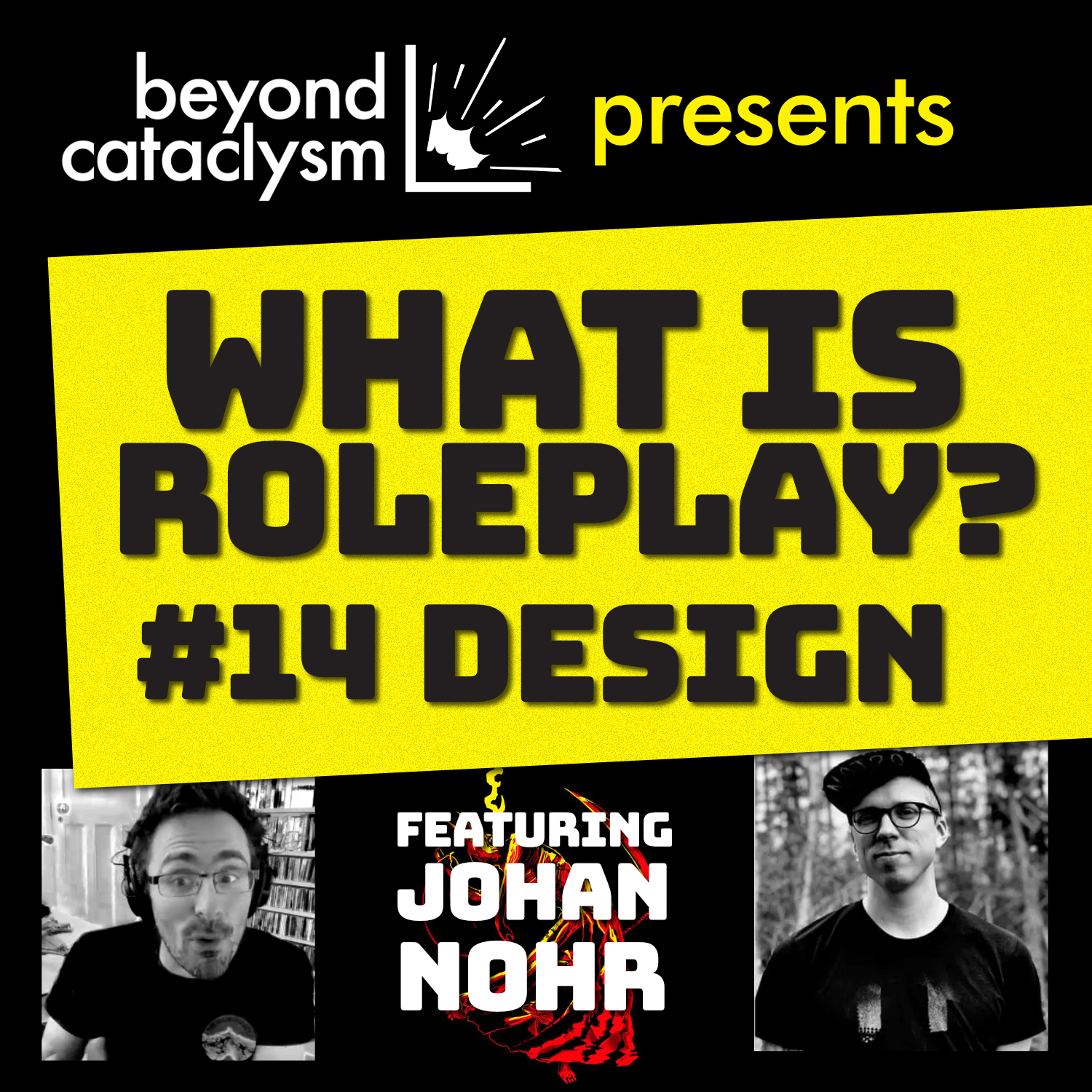
What is Roleplay #14 – Design with Johan Nohr

Welcome to Episode 14 of ‘What Is Roleplay?! 
This episode we are joined by Johan Nohr to discuss design

Everyone can draw - as adults we stop being creative because we fool ourselves into thinking that we cannot do it. How the independent games scene allows people to explore new ways of designing and laying out games that go against the safe mainstream game publishing norms How good graphic design helps to communicate the feel of the game and draws the player in The beauty of getting something hand drawn or hand made in the era of digital design Over the top art-punk designs that skew all design norms vs minimalism and the use of white space How tactility helps improve the player's experience of role playing games - use of techniques such as foiling, embossing, gloss vs matt papers and printing on the book ribbons. The differences between screen readers & printed books. The problem with PDFs being set up as if they were books when they could be better designed for onscreen use. The plus' of digital versions when it comes to accessibility. Listen as Chris & Johan do an actual play where they design a ridiculously meta game entitled 'GamePOD', intended to be published on an editable 8-track tape An encouragement to experiment with and enjoy roleplay and roleplaying games.

Links to things we discussed:

Games:

MÖRK BORG Delve Umbra Mausritter Old School Essentials CY BORG Gozr Medieval Margin-agerie MORK ORG ISBN Coffee

Books, Authors & Publishers: …

What Is Roleplay? #13 – Melee Combat with Rugose Kohn

Welcome to Episode 13 of ‘What Is Roleplay?! 
This episode we are joined by Rugose Kohn to discuss Melee Combat

Trigger warning for violence and body horror! Melee combat is usually gritty and visceral hand to hand combat as opposed to more removed and antiseptic approach such as aerial bombardment. How early roleplaying games have sort of set the standard of combat as just charging in headlong and hoping for the best where as more modern systems make that approach obsolete and involve more subtilties. Experimentation as an exciting approach to roleplaying. How gravitating towards combat can squash creativity, whilst finding other ways to deal with the encounter can open up really interesting outcomes. Systems that use interesting mechanics to deal with managing conflict such as Powered by The Apocalypse, Lichoma & Fiasco, which emphasise story telling rather than melee combat. Rugose shares a fun experience of melee combat in a game of MÖRK BORG at GenCon 2022. Chris & Rugose get into some actual play featuring a hardware store in Colorado, billy clubs, concealed hammers and a dishevelled criminal known only as Dobie. Broken arms and lost eyeballs ensue...

Links to things we discussed:

Games:

MÖRK BORG Red Box DnD Twilight 2000 Into The Odd Warhammer Fantasy RPG 5e DnD Powered By The Apocalypse Lichoma Lancer Fiasco Four Borg

Books, Authors & Publishers etc:

Stockholm Kartell Bogfolk Co-op Gen Con

Film

Monty Pythons 'Holy Grail' Conan The Barbarian Rambo Dumb & Dumber

More about Rugose

Twitter - @RugoseKohn Itch …